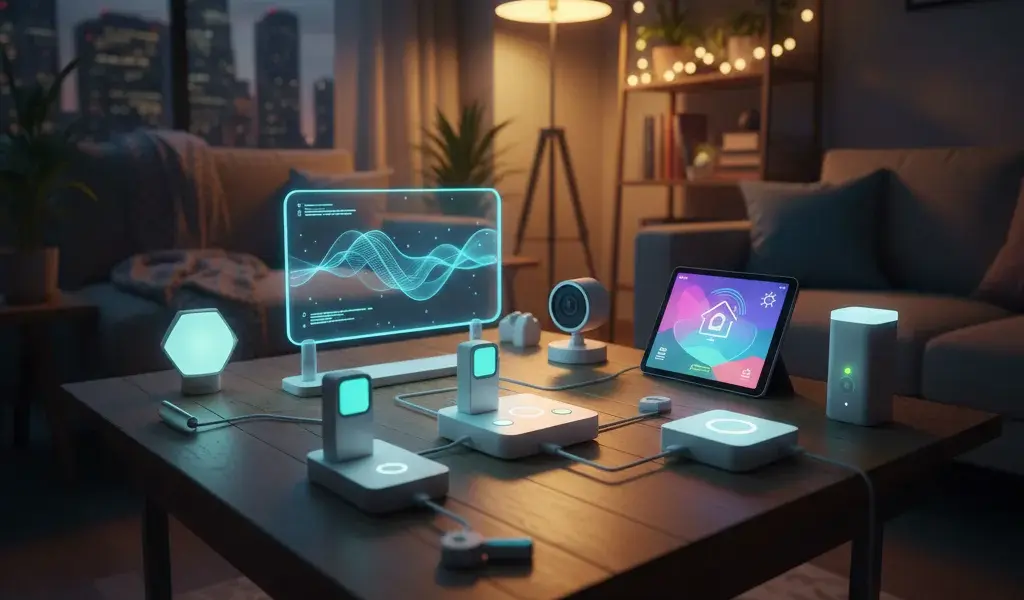
My friends thought that building a self-built smart home was something sublime, costing a lot of money and requiring workers to come and drill a lot. I used to think so too, until I personally turned my current house into a smart home at a cost not as much as a genuine "cricket". Can you believe it? In fact, building your own smart home is now as easy as eating candy, no wiring required, no technical expertise needed, but most importantly, the cost is extremely low, anyone can do it.
Busting myths: How much does it actually cost to make your own smart home?
The actual cost of building a smart home is much cheaper than you think, with only 3 to 10 million VND and you have a basic system that meets core needs such as lighting and security.
At Pham Hai, I often receive questions about the cost of building a smart home from young families. People are often haunted by quotes of hundreds of millions from large, complex construction projects. But with the DIY smart home (Do It Yourself) model, you completely control your budget. Installing a low-cost Smart Home yourself doesn't mean you have to use poor quality equipment. It's as simple as buying exactly what you really need and putting in the effort to set it up yourself instead of hiring an outside construction unit.
"Startup" package for newbies: Can you do anything under 5 million?
With under 5 million VND, you can completely set up a basic smart lighting system and automate a few small devices in the living room or bedroom.
This is an extremely ideal budget for you to test cheap smart home devices before deciding to go big. I recommend focusing on a single space, such as the bedroom or living room. You can buy a smart speaker (like a Google Nest Mini for about 600k), 2-3 Wifi smart switches (about 200k-300k/piece), and a few smart sockets to control fans or charge your phone. Just this much is enough for you to experience the extremely "lemongrass" feeling of lying in bed shouting "turn off the light". Starting small helps you get used to technology without being overwhelmed.
"Standard" package for small families: About 10 million for core utilities.
The 10 million VND package allows you to scale up to an entire 2-bedroom apartment, including lighting, basic security and temperature control.
When you are "addicted" to convenience, the 10 million level will help you have a cheap smart home solution but much more comprehensive. At this time, you can equip additional motion sensors in the hallway, door sensors for security warnings, and infrared controllers for smart air conditioners. With this level of investment, your house has begun to "think for itself". For example, if you step out of the bedroom in the middle of the night, the hallway light automatically dims, or the air conditioner automatically increases the temperature at dawn to protect your health.
Detailed analysis: Where will the money go (device, hub, accessories...)?
Most of the cost will be for terminal devices such as switches and sensors (about 60-70%), the rest is for the central controller (Hub) and accompanying accessories.
To make it easier for you to visualize and not overspend, I created a basic estimate table based on the latest updated market price in March 2026. Understanding your cash flow helps you design your own smart home more effectively and optimally.
| Device type | Reference price (VND) | Estimated budget proportion |
|---|---|---|
| Central controller (Hub) | 500,000 - 1,200,000 | 10% - 15% |
| Smart Switch/Socket | 150,000 - 500,000/piece | 40% - 50% |
| Sensors (door, motion, heat) | 150,000 - 300,000/piece | 20% - 30% |
You see, smart devices are now very diverse segments. Depending on which brand you choose, the total cost will vary a bit, but overall it's very accessible.
Where to start? 4-step roadmap to building your own smart home for non-professionals.
The 4-step roadmap includes: planning needs, choosing the right ecosystem, purchasing core equipment and finally self-installation and installation via the application.
Cách tự xây dựng nhà thông minh thực ra rất logic và tuần tự. Đừng vội vàng lướt Shopee rồi mua đồ ngay, hãy làm theo các bước làm nhà thông minh cho người mới bắt đầu dưới đây để tránh lãng phí tiền bạc và thời gian. Để hiểu rõ hơn về nền tảng kết nối vạn vật trước khi bắt tay vào làm, bạn có thể tham khảo bài viết IoT Internet of Things cho người mới bắt đầu.
Step 1: Come up with ideas and draw a "script" for your home.
Scenario planning is clearly determining what tasks you want your home to automate, in which areas and at what times, to properly address actual needs.
Don't turn your home into a technological mess just because you see someone else doing it. Take pen and paper and write down the context you really need every day. For example: "When you open the room door, the light turns on automatically", "At 11 pm, all TVs are automatically turned off and the door is locked", or "When it's hot above 32 degrees, the air conditioner automatically turns on". Determining your needs from the beginning helps you know exactly what equipment is needed to build a smart home without buying excess items that you will never touch.
Step 2: Choose where to deposit gold - Which ecosystem should you follow? (Google, Xiaomi, Aqara, Tuya…).
Choosing an ecosystem determines the compatibility of devices; Currently Matter, Tuya, Xiaomi and Aqara are the most popular and accessible options.
Hệ sinh thái nhà thông minh giống như ngôn ngữ giao tiếp của các thiết bị vậy. Cập nhật đến năm 2026, chuẩn Matter đang nổi lên mạnh mẽ giúp các thiết bị từ nhiều hãng giao tiếp chéo với nhau dễ dàng hơn qua mạng Thread. Tuy nhiên, với người mới, mình khuyên nên bắt đầu với Tuya, Xiaomi hoặc Aqara vì hệ sinh thái của họ cực kỳ phong phú và giá thành rất tốt. Nếu bạn ủng hộ hàng Việt và muốn máy chủ (server) đặt tại Việt Nam cho tốc độ phản hồi nhanh, Lumi, Hunonic, FPT Smart Home hay Điện Quang Smart cũng là những lựa chọn tuyệt vời, rất đáng đồng tiền bát gạo.
Step 3: Buy toys! Indispensable equipment for beginners.
The best "entry-level" devices include smart switches, door sensors, virtual assistant speakers, and infrared controllers.
Starting with smart lighting is the easiest way for you to immediately see the difference. Next is smart security with a compact security camera and several door sensors mounted at the entrances. If you have a little more budget, upgrading to smart door lock (opens with fingerprint/code) and smart curtains (opens automatically to let in the bright sunlight) will elevate your living space to a completely different level. If you have technical skills and like to tinker with making separate control modules, you can learn more about Arduino microcontroller programming guide.
Step 4: Manually install and install on the mobile application (easier than you think!).
The current installation process is mainly to replace old electrical equipment and connect to the wireless network, then configure everything via a very intuitive phone application.
Many people texted me and asked me if is a smart house difficult to install? I can confirm that it is NOT difficult. The current trend is completely wireless smart home installation. You just need to use a screwdriver to remove the old mechanical switch, wire it to the new switch (remember to turn off the circuit breaker first!), then open the company's mobile application. Scan for devices via Internet/Wifi connection and set up voice control via Google Home or Apple HomeKit. This process happens as quickly as you install a new app on your smartphone. To link different services and devices even more seamlessly, the IFTTT app and device automation tool is a great help.
Experience: Mistakes to avoid when installing Smart Home yourself
To avoid losing money unjustly, you need to avoid buying random products, pay attention to the old electrical system when choosing switches and synchronize network connection standards for the entire system.
In the process of learning simple smart home installation instructions, this part is the most important part that you should not ignore. From my own experience in building a smart house and countless times of "fighting fires" for customers in Pham Hai, these are notes when building your own smart house that you must keep in mind so that the system runs smoothly, without causing frustration to you.
The trap of "being cheap": Buying equipment of unknown origin and consequences.
Devices that are too cheap and unbranded often come with the risk of fire, slow response, and the risk of personal data being leaked.
Don't just buy tens of thousands of no-name switches and sockets sold widely on e-commerce platforms to save a few tens of thousands. They often use poor quality components, poor heat dissipation, and can easily cause a fire in the home's electrical network. Furthermore, the servers of these anonymous companies are extremely unstable, it takes 5 seconds for the light to turn on after pressing the phone. Prioritize choosing reputable brands such as SmartZ, Sonoff or the big brands I mentioned above to ensure absolute safety for your family.
The eternal problem: Smart switches and the pain of forgetting the "N wire".
Older houses often do not pull the N wire (cold wire) down to the base of the switch, so you must buy a smart switch that "does not require N wire" to be able to install it.
This is the most classic mistake of newbies! In the electrical system in Vietnam, especially houses built a long time ago, electricians often only pull the fire wire (L) down to the switch to save wires. If you don't check carefully and buy the wrong type of switch that requires an N wire (neutral wire/cold wire), you will cry because there is no way to connect unless you cut through the wall and re-wire. Fortunately, by 2026, most manufacturers have already produced versions of switches that do not require N wires (usually with a small capacitor to mount on the ceiling where the light bulb is) to completely solve this problem.
System mistake: Buying devices that are not in the same ecosystem (Zigbee, Wifi) and how to fix it.
Buying Wifi and Zigbee devices together without a compatible Hub will prevent them from communicating and creating a common context with each other.
You bought a door sensor that uses Zigbee but forgot to buy a Hub (central controller), as a result, it cannot connect to the network and turns into a "brick". On the contrary, devices using Wifi waves are plugged directly into your home router. It sounds convenient, but if your home has too many Wifi devices (about 20 or more), the network router will be overloaded and the network will drop continuously. Our advice is: Use Wifi for independent, less important devices; and mandatory use of Zigbee for the sensor system and main switches to ensure instant response and not clog the Internet. If you are a programmer who wants to build a powerful, secure and highly customizable central Hub, Raspberry Pi practical project for developers will open up many great ideas.
Don't be too greedy: Start with the most realistic contexts instead of making things difficult for yourself.
Prioritize setting up simple, practical day-to-day automations before trying to create complex, error-prone scenarios.
Many new players try to set up a scenario like: "Open the door -> open the curtains -> the lights change color -> the music plays -> the coffee maker runs automatically". It sounds very cool like in the movies, but in reality integrating too many conditions can easily cause errors (just one device loses its life and the whole chain stops) and sometimes causes trouble in daily activities. Focus on energy saving goals (e.g., automatically turning off bathroom lights after 10 minutes of no movement) or basic security first. If you want to go deeper and write your own small scripts to control advanced devices as desired, Learning basic Python for beginners will be an extremely useful skill.
The journey of smart home self-built smart home is not only a cost-saving problem but also an extremely interesting technology experience right in your own home. Don't let rumors about complexity or expensiveness discourage you. Just boldly start with the smallest, easiest devices, you will be surprised at what your hands can do. A smart home is not a fixed destination, but a journey of endless creative upgrades to serve your life better and better.
Have you started your smart home journey yet? Please share your "trophies" or any questions in the comments section below, I will answer them all!
Note: The information in this article is for reference only. For the best advice, please contact us directly for specific advice based on your actual needs.