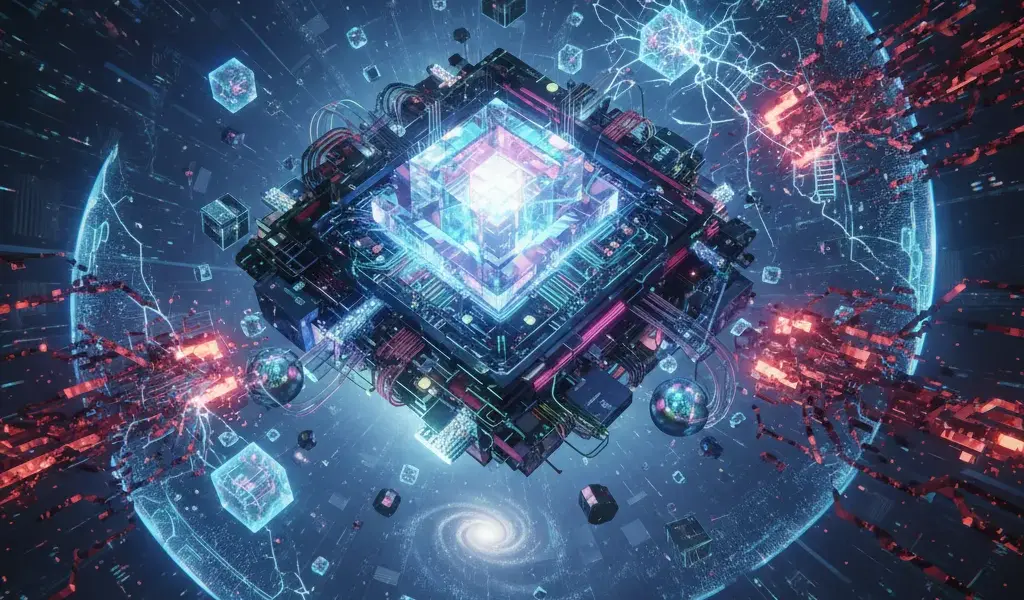
Nowadays, I see AI everywhere I go, but there is something even more "creepy" that is silently reshaping the technology game, which is quantum computers. I'm not talking about fiction, this technology exists and is about to create a real revolution. At the same time, it is also a potential nightmare for the entire network security system we rely on. In this article, as someone who has worked in the technology industry for decades, I will share the most realistic perspective on potential quantum computing. We will analyze whether it is ultimately a "breakthrough" or a "disaster" for the digital world.
Fatal double-edged sword: Break all passwords and save humanity
Quantum computers are a double-edged sword because it not only brings unprecedented breakthroughs in medicine and physics, but also has the ability to break all current security encryption systems.
"Doomsday" of cyber security: When every encryption system can be broken.
The emergence of quantum computers will make traditional encryption systems such as RSA or ECC useless in a short time. This is the biggest risk to quantum computers and cybersecurity at the present time.
In essence, current security algorithms rely on solving extremely time-consuming elemental factorization problems. But with Shor's algorithm running on a sufficiently powerful quantum machine, this defense layer will be penetrated easily. The scariest thing the information security world is facing in 2026 is the "Harvest Now, Decrypt Later" campaign (Collect first, Decrypt later).
Cybercriminal organizations and hackers are silently stealing encrypted sensitive data. They store it and just wait until the day quantum computers are perfected to unlock this entire huge block of data. At Pham Hai, we always warn businesses that if your data needs to be secure in the next 10 years, it is already at risk today.
Breakthroughs in medicine and materials science: Finding a cure for cancer and creating unbelievable materials.
Ứng dụng của máy tính lượng tử sẽ tạo ra những bước nhảy vọt trong y học và vật lý bằng cách mô phỏng chính xác cấu trúc phân tử ở cấp độ nguyên tử. Quá trình này được giới chuyên môn gọi là mô phỏng lượng tử.
Instead of blindly testing millions of chemical reactions in the lab, scientists can use this machine to find the structure of a cancer drug in just a few days. In the field of quantum materials science, this technology helps design ultra-durable solid-state batteries for electric vehicles or superconducting materials that operate at room temperature. It completely solves the physical limitations that current Supercomputers cannot overcome.
Optimize everything: From global supply chains to financial portfolios.
Lợi ích của máy tính lượng tử còn thể hiện rõ qua khả năng giải quyết các bài toán tối ưu hóa đa biến số mà máy tính thông thường phải bó tay. Quá trình tối ưu hóa lượng tử đang góp phần tiết kiệm hàng tỷ đô la cho các tập đoàn logistics và tài chính toàn cầu.
Just imagine arranging routes for tens of thousands of containers around the world to consume the least amount of fuel and avoid major storms. A classical computer would take years to calculate every possibility, but a quantum computer can come up with the optimal answer almost instantly. In the financial industry, major banks are starting to adopt this technology to balance complex investment portfolios and assess market risk in real time.
So in the end, what is so "powerful" about quantum computers?
Điện toán lượng tử là gì? Đây là một lĩnh vực công nghệ sử dụng các nguyên lý kỳ lạ của vật lý lượng tử để xử lý thông tin, mang lại sức mạnh tính toán vượt trội hoàn toàn so với các hệ thống truyền thống.
Goodbye bits, meet qubits: Core differences from classical computers.
The biggest difference when comparing quantum computers and classical computers lies in the basic information processing units: bits and qubits.
The computer you are using processes data using bits, the circuit can only have the value 0 or 1 at a time. Sohow does a quantum computer work? It uses qubits (quantum bits) made from atomic particles, ions or photons. Thanks to special physical properties, a qubit can carry the value 0, 1, or any ratio between these two values at the same time.
To make it easier to visualize, I often use this quick comparison table when discussing with colleagues:
| Core characteristics | Classic Computer (Bit) | Quantum Computer (Qubit) |
|---|---|---|
| Data status | Only 0 or 1 (Coin flips heads/tails) | 0, 1 or both (Coin is spinning) |
| Processing speed | Increases exponentially | Increase exponentially |
| Solving ability | Sequential, single problem | Multivariable, parallel problem |
Power from the "magical" world: What is superposition and quantum entanglement?.
The tremendous power of quantum computers stems from two core phenomena of quantum mechanics: superposition and entanglement.
Chồng chập lượng tử (Superposition) chính là khả năng qubit tồn tại ở nhiều trạng thái cùng lúc như mình vừa đề cập. Điều này giúp máy tính tính toán hàng triệu kịch bản song song thay vì thử từng cái một.
And quantum entanglement (Entanglement) is a strange connection between qubits. When you change the state of a qubit, the qubit "entangled" with it also changes state immediately, no matter how far apart they are. The combination of these two phenomena creates a network that processes information at a speed that the human brain can hardly imagine.
Quantum race: Who is leading and when will it "finish"?
The race for quantum advantage is currently being led by giants such as IBM, Google and Microsoft, with the goal of achieving practical applications as soon as 2026-2029.
The giants enter: Google, Microsoft, Amazon and the uncompromising war.
Giant technology corporations are pouring billions of dollars into research and manufacturing of quantum chips, each pursuing a completely separate hardware architecture.
Latest updated in early 2026, Google's Willow chip has made major strides in quantum error correction, completing super complex calculations in just a few minutes. Meanwhile, Microsoft is betting on topological qubits with the Majorana 1 chip, promising much higher hardware stability. IBM alone has announced a clear roadmap, aiming to demonstrate a scientific quantum advantage by the end of 2026 with its 120-qubit Nighthawk processor.
"Tough" challenges: Decoherence and the battle with quantum errors.
Thách thức phát triển máy tính lượng tử lớn nhất hiện nay chính là việc duy trì trạng thái ổn định của các qubit trước tác động của môi trường xung quanh.
This phenomenon is called decoherence. With just a tiny temperature fluctuation, a little noise or electromagnetic radiation, the qubit will lose its quantum state and cause serious calculation errors. That's why current quantum computer systems must be placed in deep-cooled machines at temperatures near absolute zero. Pham Hai's team realized that whoever can completely solve this error correction problem first will be the one who holds the "holy grail" of the entire industry.
2025 will be an important milestone, but when can we really "use" it?.
Khi nào máy tính lượng tử trở thành hiện thực? Năm 2025 vừa qua đã được Liên Hợp Quốc chọn là Năm Quốc tế về Khoa học và Công nghệ Lượng tử, đánh dấu sự quan tâm sâu sắc trên toàn cầu. Tuy nhiên, để đưa vào sử dụng thực tế rộng rãi như laptop thì chúng ta vẫn cần chờ thêm một thời gian.
Tương lai của điện toán lượng tử đang dần rõ nét hơn trong năm 2026 với sự trỗi dậy của mô hình điện toán lai (Hybrid Quantum-Classical). Thay vì thay thế hoàn toàn máy tính cũ, các QPU (Bộ xử lý lượng tử) sẽ hoạt động song song với GPU và CPU truyền thống để giải quyết các phần việc cụ thể. Theo lộ trình của IBM, chúng ta sẽ có những cỗ máy lượng tử có khả năng chịu lỗi (fault-tolerant) đầu tiên vào khoảng năm 2029.
AI + Quantum: When two technological "monsters" combine
The combination of AI and quantum computing creates quantum artificial intelligence (Quantum AI), which helps speed up model training and solve super complex optimization problems.
Train complex AI models in the blink of an eye.
The intersection of quantum computing and AI will provide enormous computing power to shorten the training time of machine learning models from months to just a few hours.
You can see that today's large language models (LLMs) consume extremely large amounts of power and hardware resources. When Quantum AI appears, it will optimize the data feeding algorithm, helping AI analyze huge multidimensional data sets smoothly. In this context, concepts such as AI Agent of the future of smart assistants will not only stop at responding to texts, but will also be capable of automating complex logical reasoning in real time.
Solve problems that current AI has no hands on.
Although current AI is very smart, it still faces severe hardware limitations when dealing with problems of exponentially increasing complexity.
For example, accurately predicting the folding of millions of proteins in biology or simulating the dynamic flow of global weather. Quantum AI will overcome this barrier thanks to its ability to evaluate all variables simultaneously. This is when the power of AI is truly "unlocked", bringing unprecedented values.
Can't sit and wait: Preparing for the "post-quantum" era
The post-quantum era requires organizations to immediately transition to new encryption standards to protect data against the code-breaking power of quantum computers. The construction of quantum cybersecurity must be started today.
What is Post-Quantum Cryptography?
Mã hóa kháng lượng tử là gì? Đây là các thuật toán mật mã mới được thiết kế bằng những phương pháp toán học siêu phức tạp nhằm chống lại khả năng bẻ khóa của cả máy tính cổ điển lẫn máy tính lượng tử.
Viện Tiêu chuẩn và Công nghệ Quốc gia Mỹ (NIST) đã chính thức ban hành các tiêu chuẩn mã hóa hậu lượng tử đầu tiên (bao gồm FIPS 203, 204, 205) vào tháng 8/2024. Entering the 2025-2026 period, government agencies and large businesses around the world are aggressively implementing these standards into their core network systems. The ultimate goal is to completely eliminate old algorithms before "Q-Day" comes.
Why must cyber security people and programmers learn now?
If you work in the IT industry, ignoring this cryptographic transition will be a fatal mistake, especially when working with value storage systems like blockchain or medical data.
National security directives (such as the US's CNSA 2.0) have required new security systems to be compatible with post-quantum encryption by 2027 at the latest. To proactively grasp trends and plan system upgrades, you can refer to the article on Technology trends 2026 prediction and analysis to clearly see the big picture. We need to build "crypto-agility" right into the source code, so that when variables arise, the system can switch security algorithms without crashing or interrupting service.
Quantum computers are no longer a story of the distant future. It is a fundamental change, a revolution happening right now. For those in the industry, understanding both quantum computing's potential and its threats is not an option, but a requirement to not be left behind. Don't just look at AI, start preparing the hardware, code, and mindset for a world powered by quantum power today.
Which industry in Vietnam do you think will "flourish" or "struggle" first when quantum computers become popular? Leave a comment to share your perspective!
Lưu ý: Thông tin trong bài viết này chỉ mang tính chất tham khảo. Để có lời khuyên tốt nhất, vui lòng liên hệ trực tiếp với chúng tôi để được tư vấn cụ thể dựa trên nhu cầu thực tế của bạn.