
Have you ever received an extremely convincing answer from ChatGPT, only to be stunned when you discovered it was... completely fabricated? I once got into a painful situation when using AI to synthesize reporting data for customers. This phenomenon of "AI hallucination" or AI hallucination, the problem of AI fabricating information, is not a bug, but an odd feature of large language models. Below are the 5 most practical ways to "catch" AI, helping you exploit its power without being led by false information.
What is "illusory" AI and why is it so confident in "making up" stories?
What is AI illusion? This is the phenomenon of artificial intelligence systems creating false, untrue information but presenting it extremely confidently as if it were the absolute truth.
Many users mistakenly think AI tools are like an encyclopedia containing all knowledge. In fact, large language models (LLMs) work on predicting the next word that makes the most sense according to context, rather than retrieving data from a truth store. They are superior "word prediction machines".
Because of this nature, when there is not enough information, AI will automatically "fill in the blanks" with strings of words that sound good to the ear. Notably, a study from MIT in early 2025 pointed out the "Confidence Paradox": AI is 34% more likely to use strong affirmative language (like "certainly", "undeniable") when they are creating false information than when telling the truth. This explains why the AI hallucination problem of AI fabricating information so easily bypasses us.
Bad story: When AI "composes" bogus case law
Many high-profile legal cases have occurred when lawyers used AI to search for documents, leading to the submission of court cases entirely "composed" by AI.
As of early 2026, the AI Hallucination Cases database has recorded nearly 500 cases globally involving AI fabricating legal documents. A typical example is the case in federal court in Arizona (USA), where a lawyer was fined for citing 12 completely non-existent case laws invented by ChatGPT. The judges are real, but the case is completely fake.
These incidents are not limited to inexperienced individuals. Even veteran experts become victims of fabricated information when they trust AI too much and skip the step of verifying information. This is the clearest proof that the harmful effects of AI fabricating information can destroy a person's career and reputation in the blink of an eye. To avoid falling into a similar situation, learning the tricks ChatGPT effective usage guide 2026 is a solid stepping stone that anyone needs to do today.
3 core reasons why AI "lies without blinking"
The reason AI fabricates information mainly comes from the quality of training data, limitations in AI model architecture, and overfitting in the machine learning process.
To find a way to fix AI fabricating information, we need to understand the root of the problem. There are 3 main causes leading to this phenomenon:
- Dữ liệu huấn luyện AI có vấn đề: Nếu dữ liệu đầu vào chứa nhiều thông tin sai lệch, tin giả hoặc thiên kiến dữ liệu, GenAI (AI tạo sinh) sẽ học theo và tái tạo lại những sai lầm đó một cách máy móc.
- Hiện tượng quá khớp (overfitting): Khi mô hình học quá mức thuộc lòng dữ liệu huấn luyện thay vì hiểu quy luật, nó sẽ gặp khó khăn khi xử lý các câu hỏi mới. Lúc này, AI bắt đầu đoán mò và tạo ra thông tin sai lệch.
- Bản chất kiến trúc mô hình AI: Các LLM được thiết kế để luôn đưa ra câu trả lời. Thay vì nói "Tôi không biết", chúng được lập trình để tạo ra một phản hồi có xác suất cao nhất. Thậm chí, trong năm 2026, các mô hình suy luận sâu (như o3 của OpenAI) lại có tỷ lệ ảo giác lên tới 33% ở các câu hỏi về cá nhân, vì chúng cố gắng suy luận để đoán thay vì từ chối trả lời.
Unpredictable harm: From losing essay points to information security risks
The harmful effects of AI fabricating information range from spreading fake news, causing heavy financial damage to businesses, to serious information security risks.
The AI illusion risk is more than just a harmless software bug. According to Suprmind's latest report, global financial losses caused by AI hallucination have reached a whopping 67.4 billion USD in 2024.
For individual users, believing in fabricated information can lead to wrong decisions in education, investment or health. At the corporate level, 47% of managers admitted to making wrong business decisions based on illusionary data. Furthermore, bad actors can take advantage of this loophole to create sophisticated disinformation campaigns, causing large-scale information security risks, directly threatening AI ethics and social stability.
5 ways to minimize the risk when AI "fabricates" information - My own experience
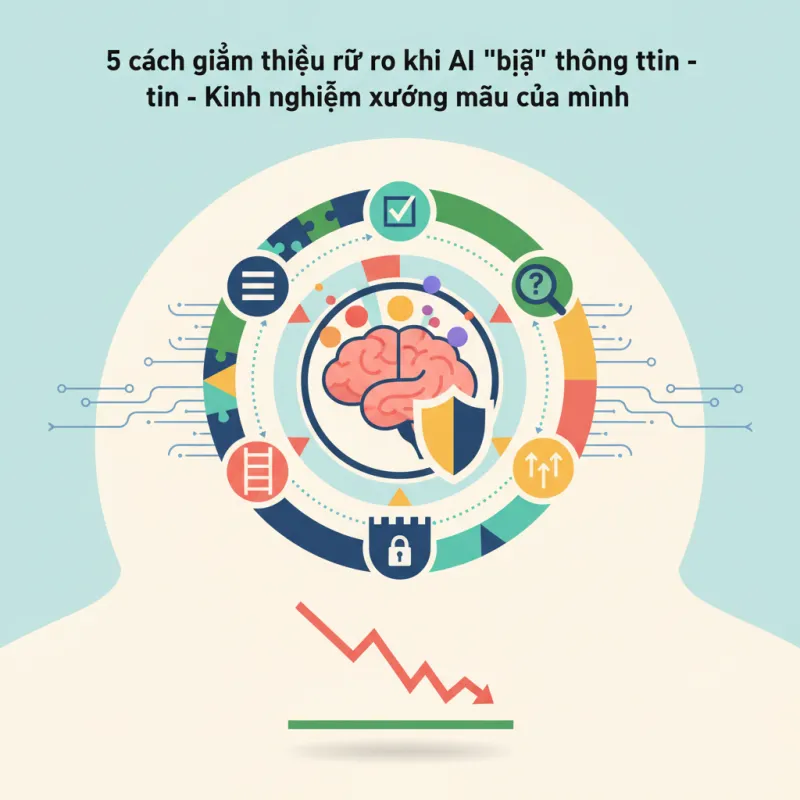
To limit AI illusions, you need to combine optimal statements, cross-verify, provide context, understand model limitations, and use RAG technology.
At Pham Hai, we realize that no model is 100% perfect. However, if you know how to minimize AI illusions, you can completely turn it into an effective assistant. Below are 5 measures to prevent AI illusions that I apply every day at work.
Method 1: Optimize commands (Prompt Engineering) - Ask correctly, AI will be "better"
Command optimization (prompt engineering) is the design of clear, detailed instructions, forcing AI to think step by step and limiting guessing.
Never ask AI general questions. Give it a specific role, clear context, and ask it to explain the inference process. Using the Chain-of-Thought technique (step-by-step reasoning) helps the model follow a strict logic, thereby significantly reducing the rate of illusions.
Besides, you should add a firm request to the command: "If you don't know the answer for sure, say 'I don't know', absolutely do not make up information." To master this skill, learning Prompt Engineering to write standard prompts for AI is a worthy investment in your productivity.
Method 2: Always verify information - Don't believe, verify!
Checking the information generated by AI is a mandatory step. You should always compare figures, quotes and facts with official sources.
AI's reliability is never absolute. No matter how smooth and professional the answer seems, you still have to act as a tough editor. According to 2026 statistics, knowledge workers are spending an average of 4.3 hours per week just reviewing AI outputs.
| Verification step | Specific actions |
|---|---|
| Kiểm tra trích dẫn | Copy the name of an article, case law or book and paste it directly into Google to see if it is real. |
| Đối chiếu số liệu | Look for original reports (from reputable organizations) to confirm the statistics. |
| Xác minh logic | Read carefully to detect internal contradictions in the AI's own answers. |
Method 3: Provide reliable context and data (Grounding AI)
Grounding AI is a method of "anchoring" the AI's answers to a realistic data set that you provide, preventing it from freely composing on the sidelines.
Instead of letting the AI rummage through its fuzzy "memory," give it specific references. For example: "Based on the text below, summarize the main content and do not add any extraneous information...".
This Grounding AI technique forces the large language model to only extract information from the source you have approved. This method helps significantly reduce factual errors, especially useful when you need to analyze high-risk legal contracts or complex medical documents.
Method 4: Understand the model's limitations - Ask the AI about the latest event and the ending
Every AI model has blind spots in terms of time (cutoff date) and areas of expertise. Understanding this helps you avoid forcing the AI to answer things it doesn't know.
If you asked a model that only updated data up to 2024 about today's gold price, it would definitely make up a number (or give out old data).
The incidence of hallucinations also varies between models. For example, in early 2026 tests, Gemini 2.0 Flash had a very low rate of hallucinations (only 0.7% for the summarization task), while some other models had much higher. To have an overview and choose the right tool for the right job, you should take a look at the article Comparing ChatGPT vs Claude vs Gemini that I have analyzed in detail. Using the wrong tools is the leading cause of the risk of AI hallucination, the problem of AI fabricating information.
Method 5: Use RAG (Retrieval Augmented Generation) integration tools
RAG (Retrieval Augmented Generation) is a technology that combines real-time information search with AI's text generation capabilities, helping to reduce the rate of illusions by up to 71%.
RAG is the "antidote" of AI that creates false information in the corporate environment in 2026. Instead of just relying on fixed training data, the RAG system will automatically search for relevant documents in internal databases or on the internet first. After that, it uses LLM to read and synthesize answers from the documents it has just found.
Thanks to RAG (Retrieval Augmented Generation), AI's answers are always accompanied by clear citations. This makes verifying information easier and more transparent than ever, contributing greatly to improving the reliability of AI.
The future of AI trust: Can we completely trust it?
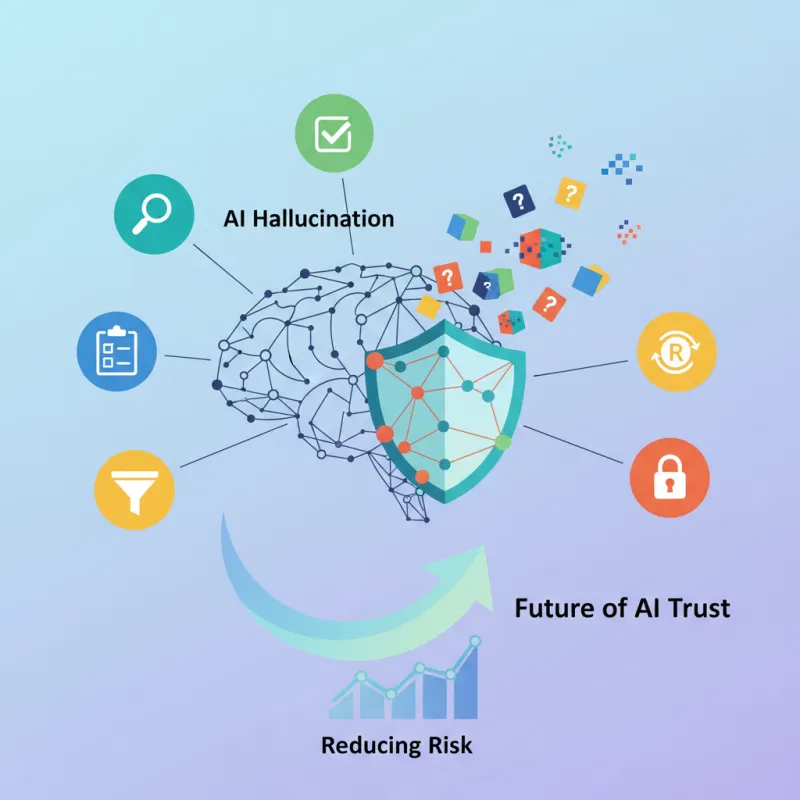
Although technology is progressing dramatically, AI's accuracy still cannot reach 100%. Completely trusting AI without oversight remains a major risk.
The AI industry is racing to solve this conundrum. The average hallucination rate has plummeted from over 21.8% (in 2021) to less than 1% in some of today's most advanced models. However, OpenAI experts have asserted that completely eliminating the illusion is almost impossible with the current LLM structure. Trust in AI needs to be built on an understanding of its limits, not blind expectations.
The fight against fake news: What are developers doing?
Tech giants are constantly updating algorithms, applying RAG, and redesigning reward systems so the model knows how to say "I don't know."
Instead of penalizing the AI when it fails to provide an answer, developers are training the AI to recognize its own uncertainty. New techniques such as "Chain-of-Verification" or authenticity assessment filters are being deeply integrated into the system. However, the fight against fabricated information is still a long process that requires efforts from both the development community and caution from users.
The ultimate role of humans: Monitoring and critical thinking
Human oversight and critical thinking are the final and most important defense against the harmful effects of AI fabrication.
Technology, no matter how advanced, is just a tool. At Pham Hai, we always emphasize that AI was born to support, not replace human thinking. Maintaining a "Human-in-the-loop" process ensures that every important decision is moderated by a true emotional, ethical, and legally responsible intelligence.
AI is like a smart assistant but sometimes a bit "dumb". It is extremely powerful, but not an all-knowing wise man. AI hallucination The problem of AI fabricating information is a reality that we have to live with in the GenAI era. Instead of blindly trusting, become a wise user, always equip yourself with critical thinking and apply the 5 methods above. Mastering AI, you will have a great tool, otherwise, you can become a victim of sophisticated fabricated information.
Have you ever been "caught" by an AI trick? Share your story in the comments so we can all "get better"!
Lưu ý: Các thông tin trong bài viết này chỉ mang tính chất tham khảo. Để có lời khuyên tốt nhất, vui lòng liên hệ trực tiếp với chúng tôi để được tư vấn cụ thể dựa trên nhu cầu thực tế của bạn.