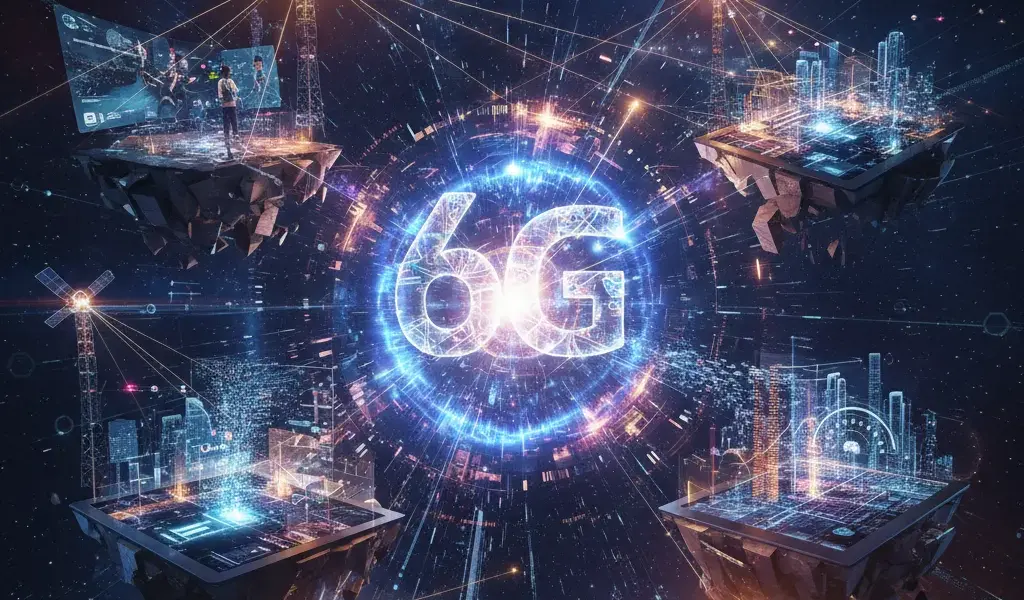
Have you ever been annoyed by network lag in the middle of a game or during an important video call? I'm always there! But imagine a future where you can download dozens of 4K movies in the blink of an eye. It's not science fiction, it's the 6G future of high-speed mobile networks that promises to completely change the game. The arrival of this sixth generation wireless technology will create a huge competitive advantage for us.
What is 6G that "people" are so excited about? Don't think it's just 5G with a "plus sign"!
6G is the sixth generation mobile network, going beyond 5G thanks to its design that integrates extensive artificial intelligence (AI) and uses Terahertz (THz) frequencies. This is the core 6G technology that creates a seamless, intelligent connection between the physical and digital worlds.
Many people mistakenly think that 6G is just a slight upgrade in bandwidth of 5G. At Pham Hai, through the research process, we realized that this is a completely different leap. To understand what 6G is, you need to look at it as an intelligent ecosystem that operates on its own.
It not only does the job of simply transmitting data, but also has the ability to sense and respond to the surrounding environment. This is possible thanks to the ability to integrate sensors directly into 6G telecommunications (Integrated Sensing and Communication - ISAC).
This shift marks an extremely important milestone in Technology trends 2026 prediction and analysis that telecommunications experts are paying special attention to. The 6G network will act as a true central nervous system.
It will connect every device from the phone in your hand to the giant industrial machines in the factory. The Internet of Things (IoT) will reach new heights, where tens of millions of devices can communicate seamlessly within an area of just one square kilometer.
Putting it on the scale: At what points does 6G "output" 5G? I'll say it a little, the speed is 9,000 times faster!
When comparing 6G and 5G, 6G network speed is expected to be 100 to 1,000 times faster (reaching 1 Tbps), with extremely low latency at the microsecond level and support a huge density of IoT devices.
If 5G is likened to an F1 racing car, then 6G is a spaceship. 6G network speed is expected to reach 1 Terabit/second (Tbps), which is 1,000 Gigabit/second. This number far exceeds the ideal 10 Gbps level of the current 5G network.
This means that 6G's broadband will allow huge volumes of data to be transmitted almost instantly. Latency is also a decisive factor. While 5G boasts 1 millisecond latency, 6G brings this number down to 1 microsecond (that's 0.001 millisecond).
Practical experience in laboratories shows that this extremely low latency level helps devices respond faster than the processing speed of the human brain. To easily visualize the difference, I created a summary table below:
| Technical criteria | Current 5G network | 6G network (Expected) |
|---|---|---|
| Tốc độ tối đa | 10 - 20 Gbps | 1 Tbps (1,000 Gbps) |
| Độ trễ tín hiệu | 1 millisecond | 1 microsecond |
| Mật độ kết nối | 1 million devices/km² | 10 million+ devices/km² |
With such dense connection density, the amount of raw data generated every second will be extremely large. Therefore, the application of Edge AI to process AI at the edge device will be a mandatory parallel solution to help the network reduce the load on the central server and respond immediately.
"Secret weapon" of 6G: Power comes from Artificial Intelligence (AI) and Terahertz frequency (THz)
The real power of the 6G network lies in the use of ultra-wide 6G Terahertz (THz) spectrum and AI-native design (integrating AI from the core), helping the network self-learn and continuously self-optimize.
Unlike previous wireless generations, 6G is designed with the "AI-native" philosophy right from the first lines of code. Artificial intelligence (AI) is not just an additional software installed on the outside layer, but it is located right in the core architecture of the network.
As of early 2026, global alliances such as the AI-RAN Alliance (with more than 130 members) are working to develop self-learning network models. They can automatically correct errors, allocate resources and optimize 6G energy savings in a completely proactive way.
At the same time, exploiting the Terahertz (THz) frequency range (from 300 GHz to 3 THz) is a vast "boulevard" for data flow. This 6G spectrum allows information transmission at a capacity unprecedented in telecommunications history.
However, to manage and handle complex tasks on this super-fast platform, we will need generations of superior virtual assistants. You can learn more about how the smart assistant's future AI Agent will leverage the power of 6G to automate every human daily task.
What is the purpose of "breaking the wind" speed? 6G applications will make you "eyes A-shaped, mouth O-shaped"
The benefits of 6G technology bring breakthrough applications such as building the virtual Metaverse, three-dimensional communication, absolute precision remote medicine and safe autonomous vehicle operation.
Fast network speed is not just for downloading movies smoothly or surfing the web without waiting. At Pham Hai, we believe that 6G's breakthrough applications will completely reshape the way humanity lives, works and interacts.
The potential of 6G in the digital era does not lie in a flat phone screen, but in the ability to blur the boundaries between the real and virtual worlds. This is realized through an advanced and synchronous digital infrastructure system.
These future experiences require perfect data seamlessness. Even to ensure transparency and security for the huge digital transactions taking place on the 6G platform, knowledge of blockchain will be very important. If you are not clear, take a look at the article What is Blockchain explained simply for newbies to grasp this core platform.
Virtual universe Metaverse and holographic communication: When "Avatar" is no longer a sci-fi movie
The 6G network provides extremely high bandwidth to realize the virtual universe (Metaverse) and smooth, vivid holographic communication calls without the need for glasses.
Imagine you're having an important meeting with a partner halfway around the world. Instead of looking through a boring 2D screen, they appear right in your living room as 3D virtual images just like real people.
Holographic communication requires transmission of "Volumetric Video" format with huge capacity in Terabytes. Only the 6G standard is capable of handling this heavy task without causing lag or broken images.
Besides, extended reality (XR) and virtual universe (Metaverse) will become the official working environment of many businesses. Holographic cities will be built and managed based on real-time digital twin technology.
An interesting example is in the entertainment media industry, 6G speed will help content creators Create AI videos from text without recording and render directly on the cloud with super sharp resolution in just a few seconds.
Telemedicine, autonomous vehicles, smart cities: A safer and more convenient future is within reach
6G's ultra-low latency allows remote surgeons to operate in absolute safety, while also helping autonomous vehicle and smart city networks operate smoothly, without blind spots.
In the field of telemedicine, even a millisecond of delay can determine a patient's life or death. 6G's 1 microsecond latency allows doctors to control surgical robot arms thousands of kilometers away.
Their operations will be conveyed with absolute precision as if they were standing right next to the operating table. This is a great step forward, demonstrating the power of innovation in modern medicine.
As for traffic, the autonomous vehicle network will continuously communicate with each other and with the smart city infrastructure. They can analyze millions of data points to predict and avoid accidents before they happen.
Furthermore, with the support of 6G satellite network with global coverage, smart manufacturing factories in the most remote areas can still operate automatically. The robots will coordinate smoothly without the need for any cables (zero-cable factories).
What about Vietnam? Opportunity to "leapfrog" in the global 6G race
Vietnam is actively preparing for the 6G era with the establishment of a Steering Committee very early, aiming to test and commercialize the 6G network in the period 2028-2030.
Many friends in the industry often ask me when will 6G launch in our country? In fact, the picture of 6G in Vietnam is not at all a far-fetched or dreamy story. We are facing a historic opportunity to "leapfrog".
This is a lever to accelerate the comprehensive digital transformation process and become a leader in the region in telecommunications technology. According to the latest updates as of early 2026, Vietnam has taken extremely clear and drastic strategic steps.
We highly appreciate the initiative of state management agencies. They planned radio frequencies early and promoted domestic technology corporations to research and master core technology.
Good signal: The 6G Steering Committee has been established since 2022!
Vietnam is one of the first 10 countries in the world to establish a 6G Steering Committee (from the beginning of 2022), laying a solid foundation for the development of national digital infrastructure.
A very proud piece of information that you may not know: Vietnam is in the top 10 countries in the world with a national 6G Steering Committee. Most recently, at the end of February 2026, Ho Chi Minh City officially issued a research and development plan.
They plan to pilot 6G technology in some key areas in the city this year. The national strategic goal is to be ready for frequency licensing and 6G testing by 2028, moving towards commercialization by 2029-2030.
This clearly demonstrates that we are not behind in the global race. Major domestic carriers are actively cooperating with international alliances to prepare infrastructure. Autonomous design of sixth-generation wireless technology will help Vietnam not be dependent on imported equipment.
The challenge is not small: From infrastructure, costs to network security
6G deployment faces many major challenges in terms of investment costs in dense broadcast station infrastructure, hardware technical barriers and complex 6G network security risks.
Of course, the road to 6G is not filled with roses. The biggest 6G development challenge for Vietnam as well as the world is the economic and physical infrastructure problem.
Due to the use of Terahertz waves with extremely short wavelengths, 6G signals are easily attenuated and obstructed by physical objects such as walls and trees. This forces carriers to build a network of mini broadcast stations dozens of times denser than the current 5G.
In addition, 6G network security is also a deep concern. As billions of IoT devices, from cars to heart rate monitors, are constantly connected across a network, the hacker attack surface will expand like never before. Protecting data security requires us to apply extremely complex quantum encryption standards.
Clearly, 6G the future of high-speed mobile networks is not simply a bandwidth upgrade to download files faster. It is a profound revolution, reshaping the entire digital economy and creating vital competitive advantages for businesses and countries. For techies like me and you, embracing the intersection of 6G, AI and the Metaverse now is no longer a choice, but a requirement to innovate and lead.
Which application of the 6G network do you think will "explode" and bring the highest practical value in Vietnam within the next 5 years? Please leave your thoughts in the comments section below, let's discuss!
Note: The information in this article is for reference only. For the best advice, please contact us directly for specific advice based on your actual needs.